
Last month, with the close out of the financial year in Australia there was a modest increase in the price for LGCs (Large-scale Generation Certificates), to in excess of $8 per certificate but subsequently prices have settled to around $5, after being as low as $2, earlier in the year. Paul Mcardle of Global Roam explored these prices in some detail just recently. Spot LGC prices down the gurgler… – WattClarity
Looking at trading activity in these certificates, we can observe that there is at best, a modest increase in trades this year, even though prices are much lower than 2025.
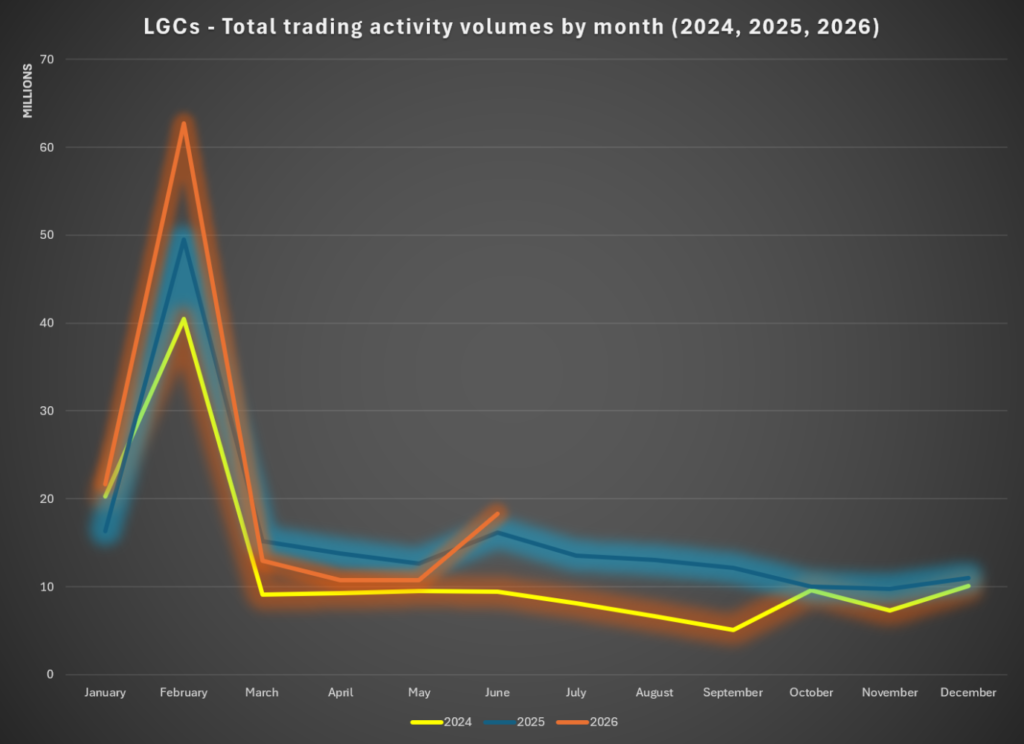
There has also been some speculation that data centres may have been responsible for the lift in prices in June, due to increased demand but the busiest day in the month (29th of June), was dominated by trading houses, banks and large retailers. i.e. without the detail of specific trading prices, it’s not clear who paid up, but it was not particularly remarkable.
However, it’s worth exploring data centres in more detail around the use of renewable energy as it’s been getting a lot of attention in the media of late. Early last year, I wrote an article on Watt Clarity about the approaches data centres may need to consider when sourcing “clean energy” Data centres, clean energy and net zero ambitions – WattClarity
Data Centres Australia represents the industry in Australia (Data Centres as Enabling Infrastructure – Data Centres Australia). According to Data Centres Australia, the industrry used 3.9TWh of electricity in 2025 (about 2% of electricity demand), with an ambition of sourcing at least 70% renewable energy, underpinned by contracted PPA’s from renewable energy projects and rooftop contributing 1.5TWh per annum. Notably, some data centre providers such as Amazon (which runs AWS data centres and its e-commerce businesses) have publicly announced PPAs which either partly of fully support wind and solar projects (Amazon Australia signs nine new renewable energy deals taking Australian capacity to nearly 1GW – About Amazon Australia.
It must be noted that to meet a renewables target by voluntarily surrendering LGCs does not require specific levels or timing around certificate surrender as compared to those under the renewable energy target (i.e. retailers and large loads will need to surrender LGCs equivalent to 16.67% for 2026 on February 14, 2027) As an example, the ACT government accumulated LGCs for a few years before surrendering to meet its 100% renewables target from 2020. The exception is Greenpower (Renewable energy made easy) which is administered by the NSW government and allows retailers to supply additional renewable energy to their customers by purchasing LGCs and surrendering regularly under this scheme with greater rigour and audit.
Other data centre operators such as CDC Data Centres, and NextDC participate in LGC purchases, as well as other businesses that have data centres in their portfolio such as Fujitsu, Telstra and Goodman. Current purchases to the end of June are about 0.6TWh for direct participants, similar to last year at this time. To meet a 70% renewables target requires about 2.7TWh. Whilst there are regular future purchases to be made, likely forward agreements and some data centres may have a retailer to manage their LGC needs, it looks likely that data centres may need significantly more purchases as an industry to meet these targets, but with the only restriction being a need to surrender by 2030 they may have sufficient time to act.
It’s also worth noting that some of these businesses are carbon neutral for their administrative function and that they give their customers the option of choosing whether or not they wish to have renewable power managed by the data centre or offset data centre energy use themselves (or not at all). It would be anticipated that some businesses preferred carbon neutrality by buying offsets as this was a cheaper option than sourcing renewable energy. Recently, the federal government announced that its “Climate Active” scheme is to be closed, so with LGCs at around $5 presently, data centres can supply renewable energy for less than 0.5c/kWh of additional cost, making it relatively more attractive than carbon neutrality. Perhaps with prices so low and a predicted shortfall in purchases, we may see increased future interest from data centres…??